Designing AI UX for High-Stakes Industry
Patterns I’ve Built To Support Complex Workflows In Healthcare
Insights
Dec 12, 2025
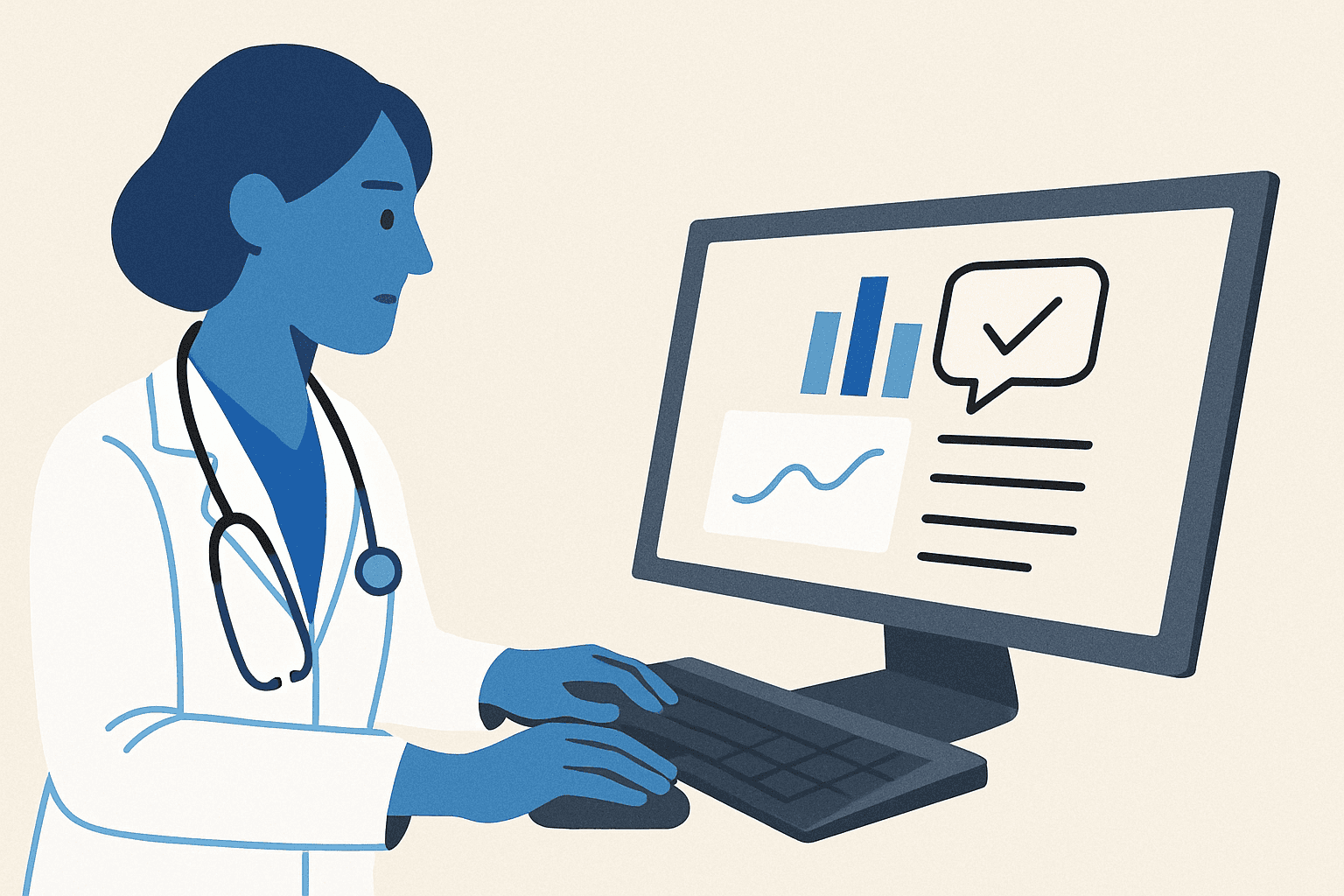
(Image credited: GPT generated)
If you’re reading this—welcome. I’m Grace, a UX designer and strategist working in AI solutions in the high-stakes healthcare industry.
This article focuses on the design patterns I’ve developed and learned from the past, applied to data-intensive products for clinicians and medical data science experts. These patterns emerged from real needs: managing cognitive load, communicating uncertainty, and making insights actionable without overwhelming professionals who already navigate enormous data complexity.
The Core Challenge: Beyond Today’s Tools
Clinicians and data specialists operate in high-pressure, time-constrained environments, yet many existing tools still rely on static views, fragmented data, and manual synthesis—often across multiple models, tools, and systems. As a result, users are left to stitch together outputs, translate signals, and manage handoffs on their own.
AI-enabled interfaces must move beyond information delivery to intelligent task support:
streamlining workflows across models/tools/systems, aligning insights toward user goals
involving human verification steps without oversimplification.
strengthening decision-making without introducing new risk.
This tension directly shaped the patterns that follow.
Pattern 1: Aggregated Insights to Support Prioritization
When users face numerous signals, indicators, or risk factors, aggregation helps them quickly focus on the most critical elements.
A well-designed summary layer acts as a triage tool, guiding attention while still allowing deeper exploration.
Pattern 2: Insight Visualization and Data Metrics
Visual interpretation reduces the cognitive burden of raw, multidimensional data. Thoughtful visual metaphors- help experts recognize the adverse event or provide a high-level picture summary from relevant data.
Pattern 3: Scenario Exploration and Input Configuration
Clinicians often think in “what if” language. Enabling them to adjust parameters and generate insights based on hypothetical scenarios increases trust and encourages deeper reasoning.
This also reveals model limitations through interaction, not hidden fine print.
Pattern 4: Communicating Model Confidence with Timing and Visual Cues
Model confidence is dynamic. Representing it requires more than a percentage:
Progressive disclosure
Subtle timing and animation
Contextual emphasis rather than static badges
These elements help users understand when the model is reliable—and when to double-check.
Pattern 5: Trust-Building Through Explanation Layers and Intentional Friction
In healthcare, friction can sometimes serve as a safety feature. Explanation layers, confirmation modals, signal highlights, and inline rationale all help users assess risk before acting.
Clarity and caution are not opposites; they are partners.
Closing
Regulation makes it clear that AI will not—and should not—make final diagnostic decisions. Human-in-the-loop review and sign-off will remain essential, across both direct patient care and downstream analytical workflows.
The opportunity ahead is not to automate judgment, but to design AI systems that evolve into trusted collaborators—streamlining work across models, surfacing the right signals at the right moment, and reinforcing human expertise. This requires design patterns that supplement the complexity of professional workflows, rather than simplifying them into something they were never meant to be.
If you’re interested in the research and references that shaped these patterns, I share more in the next article.
Designing AI UX for High-Stakes Industry
Patterns I’ve Built To Support Complex Workflows In Healthcare
Insights
Dec 12, 2025
(Image credited: GPT generated)
If you’re reading this—welcome. I’m Grace, a UX designer and strategist working in AI solutions in the high-stakes healthcare industry.
This article focuses on the design patterns I’ve developed and learned from the past, applied to data-intensive products for clinicians and medical data science experts. These patterns emerged from real needs: managing cognitive load, communicating uncertainty, and making insights actionable without overwhelming professionals who already navigate enormous data complexity.
The Core Challenge: Beyond Today’s Tools
Clinicians and data specialists operate in high-pressure, time-constrained environments, yet many existing tools still rely on static views, fragmented data, and manual synthesis—often across multiple models, tools, and systems. As a result, users are left to stitch together outputs, translate signals, and manage handoffs on their own.
AI-enabled interfaces must move beyond information delivery to intelligent task support:
streamlining workflows across models/tools/systems, aligning insights toward user goals
involving human verification steps without oversimplification.
strengthening decision-making without introducing new risk.
This tension directly shaped the patterns that follow.
Pattern 1: Aggregated Insights to Support Prioritization
When users face numerous signals, indicators, or risk factors, aggregation helps them quickly focus on the most critical elements.
A well-designed summary layer acts as a triage tool, guiding attention while still allowing deeper exploration.
Pattern 2: Insight Visualization and Data Metrics
Visual interpretation reduces the cognitive burden of raw, multidimensional data. Thoughtful visual metaphors- help experts recognize the adverse event or provide a high-level picture summary from relevant data.
Pattern 3: Scenario Exploration and Input Configuration
Clinicians often think in “what if” language. Enabling them to adjust parameters and generate insights based on hypothetical scenarios increases trust and encourages deeper reasoning.
This also reveals model limitations through interaction, not hidden fine print.
Pattern 4: Communicating Model Confidence with Timing and Visual Cues
Model confidence is dynamic. Representing it requires more than a percentage:
Progressive disclosure
Subtle timing and animation
Contextual emphasis rather than static badges
These elements help users understand when the model is reliable—and when to double-check.
Pattern 5: Trust-Building Through Explanation Layers and Intentional Friction
In healthcare, friction can sometimes serve as a safety feature. Explanation layers, confirmation modals, signal highlights, and inline rationale all help users assess risk before acting.
Clarity and caution are not opposites; they are partners.
Closing
Regulation makes it clear that AI will not—and should not—make final diagnostic decisions. Human-in-the-loop review and sign-off will remain essential, across both direct patient care and downstream analytical workflows.
The opportunity ahead is not to automate judgment, but to design AI systems that evolve into trusted collaborators—streamlining work across models, surfacing the right signals at the right moment, and reinforcing human expertise. This requires design patterns that supplement the complexity of professional workflows, rather than simplifying them into something they were never meant to be.
If you’re interested in the research and references that shaped these patterns, I share more in the next article.
Designing AI UX for High-Stakes Industry
Patterns I’ve Built To Support Complex Workflows In Healthcare
Insights
Dec 12, 2025
(Image credited: GPT generated)
If you’re reading this—welcome. I’m Grace, a UX designer and strategist working in AI solutions in the high-stakes healthcare industry.
This article focuses on the design patterns I’ve developed and learned from the past, applied to data-intensive products for clinicians and medical data science experts. These patterns emerged from real needs: managing cognitive load, communicating uncertainty, and making insights actionable without overwhelming professionals who already navigate enormous data complexity.
The Core Challenge: Beyond Today’s Tools
Clinicians and data specialists operate in high-pressure, time-constrained environments, yet many existing tools still rely on static views, fragmented data, and manual synthesis—often across multiple models, tools, and systems. As a result, users are left to stitch together outputs, translate signals, and manage handoffs on their own.
AI-enabled interfaces must move beyond information delivery to intelligent task support:
streamlining workflows across models/tools/systems, aligning insights toward user goals
involving human verification steps without oversimplification.
strengthening decision-making without introducing new risk.
This tension directly shaped the patterns that follow.
Pattern 1: Aggregated Insights to Support Prioritization
When users face numerous signals, indicators, or risk factors, aggregation helps them quickly focus on the most critical elements.
A well-designed summary layer acts as a triage tool, guiding attention while still allowing deeper exploration.
Pattern 2: Insight Visualization and Data Metrics
Visual interpretation reduces the cognitive burden of raw, multidimensional data. Thoughtful visual metaphors- help experts recognize the adverse event or provide a high-level picture summary from relevant data.
Pattern 3: Scenario Exploration and Input Configuration
Clinicians often think in “what if” language. Enabling them to adjust parameters and generate insights based on hypothetical scenarios increases trust and encourages deeper reasoning.
This also reveals model limitations through interaction, not hidden fine print.
Pattern 4: Communicating Model Confidence with Timing and Visual Cues
Model confidence is dynamic. Representing it requires more than a percentage:
Progressive disclosure
Subtle timing and animation
Contextual emphasis rather than static badges
These elements help users understand when the model is reliable—and when to double-check.
Pattern 5: Trust-Building Through Explanation Layers and Intentional Friction
In healthcare, friction can sometimes serve as a safety feature. Explanation layers, confirmation modals, signal highlights, and inline rationale all help users assess risk before acting.
Clarity and caution are not opposites; they are partners.
Closing
Regulation makes it clear that AI will not—and should not—make final diagnostic decisions. Human-in-the-loop review and sign-off will remain essential, across both direct patient care and downstream analytical workflows.
The opportunity ahead is not to automate judgment, but to design AI systems that evolve into trusted collaborators—streamlining work across models, surfacing the right signals at the right moment, and reinforcing human expertise. This requires design patterns that supplement the complexity of professional workflows, rather than simplifying them into something they were never meant to be.
If you’re interested in the research and references that shaped these patterns, I share more in the next article.